



New
Your Journal Is the Cheapest Mentor
I was never afraid of losing a single trade. I was afraid of opening the file and reading back exactly how I lost — and that fear kept me stuck in the same loop for almost a year. The cure turned out to be the most boring tool I owned: a trading journal I had created and never opened.
The night I stared at an empty file called nhat-ky.xlsx
Two in the morning. The laptop still glowing in a dark room, the account down one more trade. I opened an old folder looking for a distraction, and there it was — a spreadsheet named nhat-ky.xlsx. I had created it three months earlier, the night I promised myself I’d log every trade and finally get better.
Empty. Three months. Not one line.
I sat looking at it for a long while. And for the first time, I stopped blaming and told myself the honest reason it was blank. Not because I was busy. Because I was afraid. Afraid to read back, in black and white, what I had actually done — the gut-feeling entry at midnight, the stop loss I dragged wider because I couldn’t stand being wrong, the revenge trade I slammed in after a blow-up. That empty file wasn’t laziness. It was a hiding place — and the hiding is what had jailed me for three months.
I had always believed I lost because the market was hard, because news dropped, because some wave swept my stop. That night I swallowed a harder truth: I wasn’t losing to the market. I was losing because I had never once sat down and looked at myself properly.
Memory is a lying witness. It zooms in on the winning trade so I feel sharp, then quietly deletes the loser so I don’t have to hurt. The truth about a trader isn’t in his head — it’s on the page he’s brave enough to write.
It’s like photography. You don’t improve by vaguely remembering a ruined photo. You improve when you open it, look straight at the blown-out highlight and the missed focus — and shoot the next one differently. And here’s what I want to say straight to you, reading this while you’re also down: you repeat the same mistake not because you’re hopeless. It’s because you’ve never once written it down where you could see it clearly, and kindly.
That empty file wasn’t my failure. It was an invitation. That night, I double-clicked it.
How to keep a trading journal: turning expensive experience into a lesson you keep
After that losing streak, I didn’t go hunting for a new indicator. I opened a blank file and started logging every trade.
Not to brag. To face it.
The first time, I wrote exactly four lines for one trade: reason for entry, exit and stop, the one-word emotion when I clicked, and a single-line lesson. Sounds easy. But my hand froze at the emotion line. Because the truth I had to type was: I entered this one on FOMO. That other one, I moved the stop loss for no analysis at all — only because I refused to admit I was wrong. Naming your own mistake by its real name — nothing is harder.
But that was exactly when I understood: the discomfort was proof it was working. A journal isn’t built to soothe you — it’s built to make you see what’s true. It’s not a comfort blanket; it’s a mirror. I used to treat logging as paperwork, one more chore after a tiring day. I was wrong. A journal isn’t admin. It’s how you refuse to pay the same tuition twice.
I thought about the kilometers I run. No serious runner lives on a fuzzy memory of last week’s session. They improve by reopening the log — distance, heart rate, the point where the legs gave out — and fixing the next run. The page does the one thing the mind always dodges: it tells you straight.
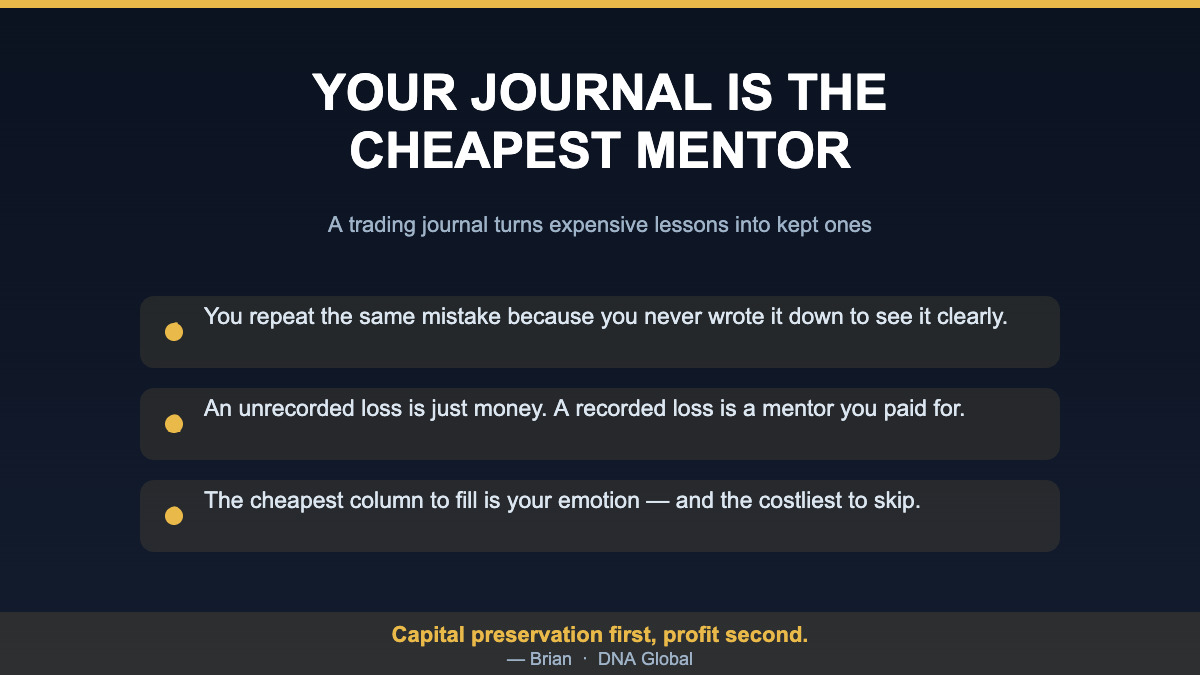
And here’s what I believe, now passed to you: the most expensive mentor of my life was a page recording my own mistakes — and the strange part is, that mentor never charged me another cent. A loss you don’t record is just money gone. A loss you do record is a mentor you already paid to bring home — don’t let him leave empty-handed.
What to write in a trading journal: four lines that beat a year of guessing
Knowing the value of a journal is one thing. Knowing what to put in it is another — and this is exactly where I tripped at the start.
I used to think a good trading journal had to be thick. Fifteen columns. Color-coded. Formulas baked in. I built it as carefully as building a ship — then never climbed aboard. Because a fifteen-column template is a promise you’ll break by the third trade.
Photography taught me one thing: the great shot isn’t the one with the most in the frame, it’s the one that cut everything spare so the subject pops. A journal is the same. Four true lines beat ten pretty ones.
Here are those four lines. Keep it this simple — and treat it as an example, not financial advice:
- One — the REASON for the entry. What’s the setup, written BEFORE you click. No “I feel.” “I feel like it’s about to go up” is not a reason — it’s a prayer.
- Two — the planned EXIT and STOP LOSS. Written in advance, so you don’t argue with yourself later.
- Three — the EMOTION at the click. One word only. Fear. Greed. Revenge. Confidence. This is the most expensive column in the book. The entry point isn’t the problem — risk and emotion are. One honest word here says more than a full page of technical analysis.
- Four — the LESSON, one line, after you close.
| Reason for entry | Exit + Stop | Emotion (1 word) | Lesson |
|---|---|---|---|
| Break of H1 resistance | TP 1980 / SL 1965 | Confident | Right setup, kept the plan |
| Price running, scared to miss | (none) | FOMO | No plan = a loss, even if it pays |
A four-column trading journal template: reason for entry, exit and stop loss, one-word emotion, one-line lesson.
Look at the second row. That trade may have made money. But in the journal, it’s a LOSS. Because you won by breaking your rule — and next time, that same broken rule comes back to kill you.
This is the line that separates the professional from the hobbyist: the hobbyist scores by profit, the professional scores by whether the plan was followed. Don’t grade your trades by money — money is only the delayed score of your discipline.
Handwriting, Excel, or an app — it doesn’t matter. Honesty in the third column does. React, don’t predict — and to react well, you first have to look squarely at how you reacted last time.
Review your trades on a schedule: where the error pattern finally shows its face
But logging and closing the app — that’s only half. The other half, the half that genuinely bent me back into shape, is sitting down and READING IT BACK.
I pick Sunday morning. One coffee, open the file, read back every line from the week. While writing, each trade is a lonely island — entered for one reason, exited for another, nothing connecting. But lay all the losing trades side by side on one page, and the pattern memory kept hidden crawls out into the light.
That week I counted. Seven of ten losing trades came after 10 p.m. When I was tired. When I’d just eaten a loss and wanted it back immediately. It wasn’t the market hurting me. It was me — at one in the morning, bitter, demanding payback.
Dig one layer deeper, and almost none of my losses came from a hundred different errors. They funneled into the same few emotional mistakes. The revenge entry after a loss. Moving the stop because I couldn’t swallow being wrong. Holding a red trade because my ego wouldn’t let me cut it. A few ghosts, back every week, each wearing a different face.
And here’s the most valuable thing a journal taught me:
“I don’t have what it takes” is a vague sentence. “I keep taking revenge trades at one in the morning” is a problem with an address — and anything with an address can be fixed.
See the difference? One sentence makes you give up. The other hands you something to do tonight.
It was like learning to swim. I assumed my stroke was clean — until the coach filmed me and showed me my shoulder collapsing, my form breaking at exactly the thirtieth meter. A journal is the slow-motion replay of your own mind at the instant your finger hit the button.
Reviewing the journal is when I stopped blaming the market and stood up out of the victim’s chair. You don’t beat the market — you only beat the impatient version of yourself. And it only shows its face on a journal page you have the guts to read back.
From blaming the market to owning yourself
I need to say one thing plainly, in case you misread me.
I’m not selling you a magic notebook. There’s no “10x your account overnight” — I don’t have it, nobody does. This profession has no get-rich-quick. I’ve paid enough to know that’s a fact, not a slogan.
My biggest enemy in the early years wasn’t the market — it was my own memory. Always defending me, always painting it rosy. I sat in the victim’s seat for a long time, blaming the broker, the news, the “malicious” wave that swept exactly my stop loss. The page is what flipped me face-up. It defends no one. A wrong trade is a wrong trade, black and white, no room for a midnight excuse.
And when I stopped blaming the market, something strange happened: I started to gain power. Not power over price — no one has that. Power over my own reaction to price. You can’t change the wave, you can only change the person standing on the board. That is the entire difference between a victim and an owner.
People look at the Porsche 911, the watch, and assume those are the destination. They’re not. They’re only reminders — of the nights I sat down and named my own mistakes by their real names, when no one was clapping. Everything beautiful in my life grew out of that, not out of the thing I was chasing.
And this is why I don’t walk alone. Alone is fast. But to go far, I need a team that reviews together and dares to name each other’s mistakes. I chose to go far. My mission was never to be a signal-calling star — it’s to build a place where each person picks up the pen, stands up, and owns their own life. Discipline, after all, is what creates freedom — and the journal is where that discipline gets built.
Tonight, four lines — don’t shut the laptop yet
Back to the late-night room from the opening. The file nhat-ky.xlsx is still open, still empty. But tonight is different.
I keep talking about the trading journal not to sell you a magic notebook. The cheapest mentor a trader has isn’t inside an expensive course or some secret playbook. It’s inside the empty file you already own — you just haven’t opened it.
Don’t rewrite the whole past year. That year is gone. Tonight only. After your next trade — win or lose — don’t shut the laptop. Type exactly four lines:
- The reason I entered.
- The exit and stop loss I set.
- One word for the emotion at the click.
- One lesson after I closed.
Four lines. Under two minutes. Not to mourn the past, but so the next trade goes in a little clearer than this one. An owner isn’t someone who never loses — it’s someone who, each time they lose, walks away with a line of data instead of a wound. You don’t need to fix the old year. You just need to not shut the laptop tonight, and let the cheapest mentor start teaching you from the very next trade.
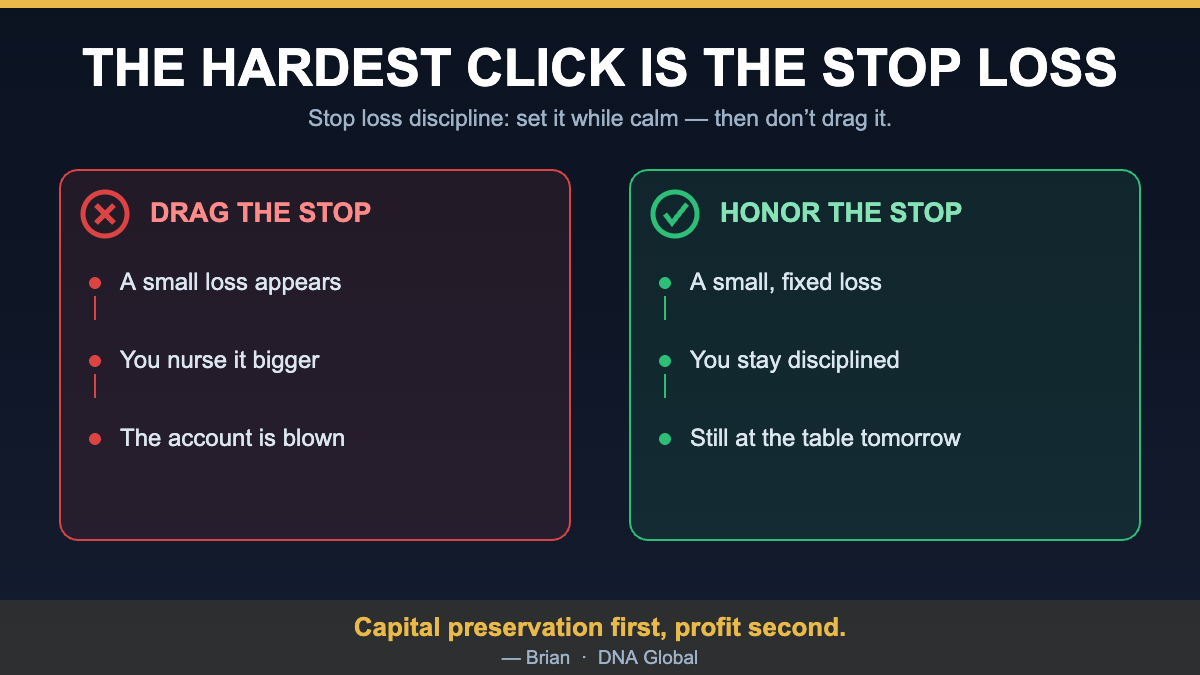
And if reviewing your journal alone every weekend feels lonely — I get it. Together is far. Our community stays open for anyone who wants to train alongside others — not for me to call the trades, but so we can look back at ourselves honestly, together. If the hardest part is still cutting the trade, that’s a muscle worth building too: The Hardest Click Is the Stop Loss.
Open the file. Type the first line.
Your journal is the cheapest mentor. Not a soothing nanny — a mirror. Let it start tonight.
— Brian
About the author
Brian — founder of DNA Global, a training community for Forex and gold (XAUUSD) traders. Brian once believed “the right entry changes your life,” took losses and paid his tuition, then pulled out the core lesson about capital, emotion, and discipline. He chose to build a SYSTEM and a TEAM instead of being a “signal-calling star.” Away from the market, Brian runs marathons and swims — where he learned that everything beautiful is a byproduct of discipline.
FAQ
What is a trading journal?
It’s where you record each trade: the reason for entry, the planned exit and stop loss, the one-word emotion at the click, the result, and a one-line lesson. The point isn’t tidy archiving — it’s reviewing on a schedule so the repeating error pattern finally surfaces.
Should I keep my trading journal in Excel, an app, or by hand?
Any tool works — Excel, a dedicated app, or a paper notebook. What decides the outcome isn’t the format; it’s honesty in the emotion column and whether you actually sit down to read it back.
How often should I review my trades?
At minimum every weekend, plus one wrap-up at month’s end. Reading back is when the error patterns memory kept hidden show their faces — that review is what creates change, not the act of logging.
I’m just starting — how much should I write to learn from trading mistakes?
Just four lines per trade: reason for entry, exit + stop, one emotion word, one lesson. Don’t build a ten-column template for looks and quit after three days. The short version you actually keep beats the elaborate one you abandon.
Trading Forex and gold (XAUUSD) always carries the risk of capital loss; this content is shared experience and educational perspective, not investment advice or any promise of profit.
— Brian