





New
Capital Management for Beginners: The Art of Staying in Shallow Water
Beginners often ask me one question: “How do I enter so I win?”
That’s the wrong question — because if you lose 50% of your account, you have to make 100% just to get back to break even.
Read that number again. Lose half, and you have to double what’s left just to break even.
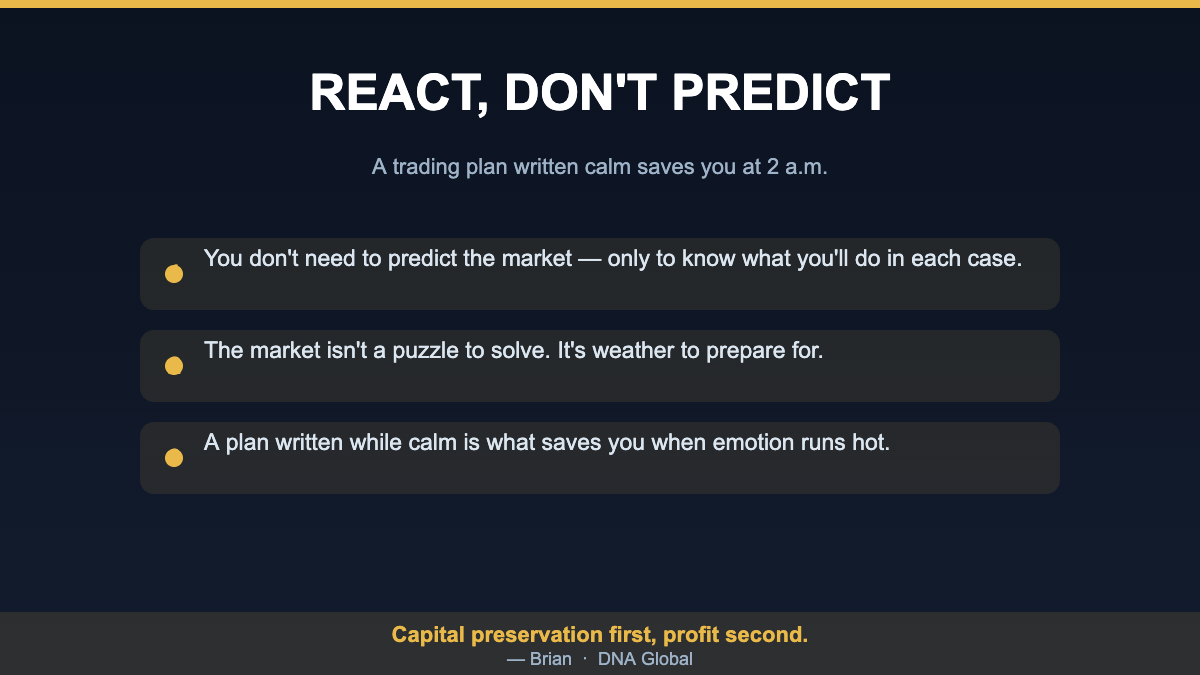
The market doesn’t require you to be a great forecaster to survive. It only requires you not to shoot yourself in the foot.
And 90% of beginners who lose don’t lose because their analysis is poor. They lose because they never learned to manage capital.
This article is what I wish someone had told me before I lost my first account.
The biggest enemy of a beginner
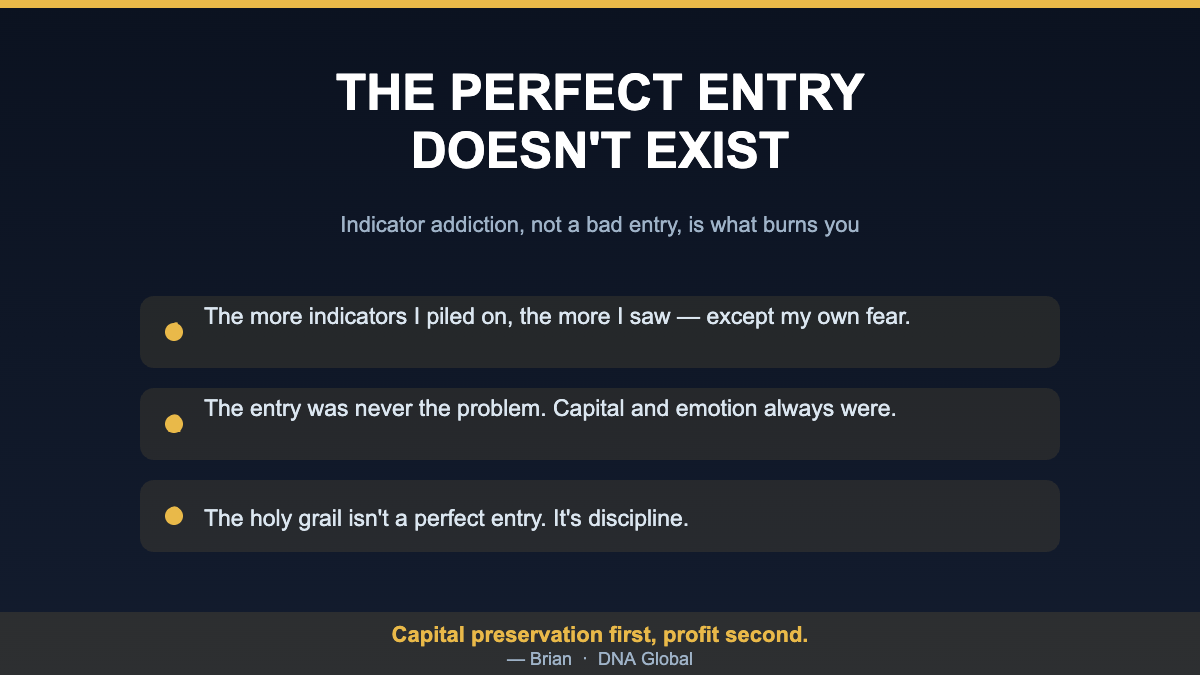
Notice what the internet sells to beginners. “Magic” indicators. Entry signals. Courses on “reading candles to call tops and bottoms.” Everything revolves around one question: where to enter.
Almost no one talks about the far more important question: if I’m wrong, how much do I lose. Why? Because a “hot setup” is easy to sell, while capital management sounds boring.
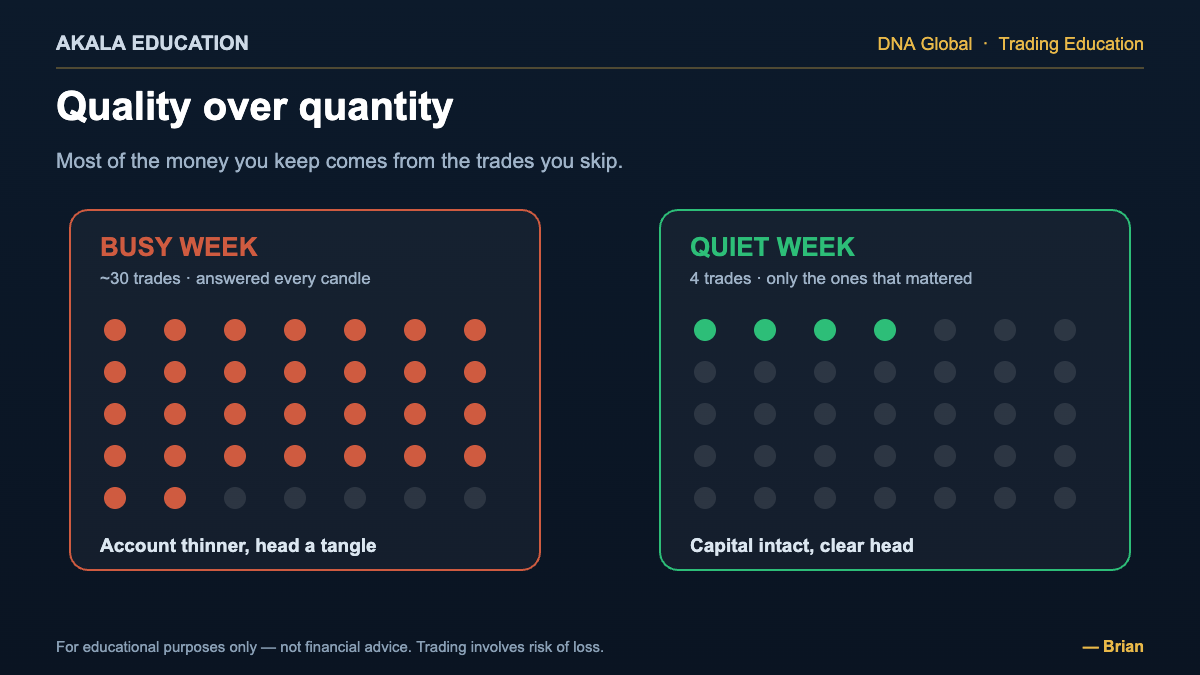
But here’s the blunt truth. Your entry decides whether you profit on a single trade. Capital management decides whether you survive after a hundred trades. Beginners die because they learn the order backwards.
The cruel math of losing capital
This is the least exciting but most important part of the whole article. Losing money is not symmetric with winning it back.
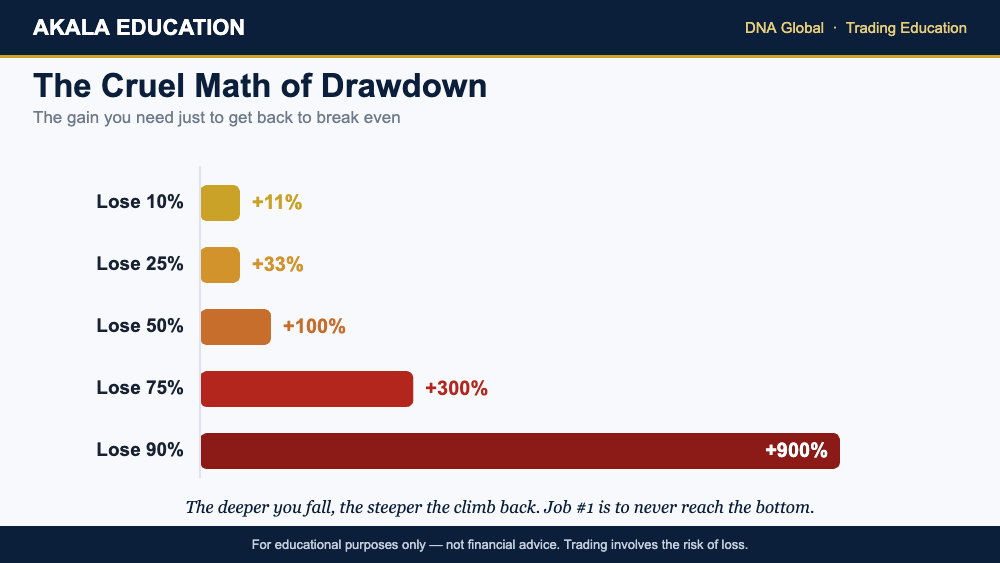
Lose 10% — you need +11% to recover. Lose 25% — you need +33%. Lose 50% — you need +100%. Lose 75% — you need +300%. Lose 90% — you need +900%.
See the trap? The deeper you sink, the steeper the climb back. An account that’s down 90% almost can’t come back, no matter how good the trader is.
So your number one job isn’t to make a lot. It’s to never let yourself fall to the bottom of that pit. Capital management, in the end, is the art of staying in shallow water.
Four rules for beginners
I keep it as simple as possible.
1. Risk no more than 1% per trade
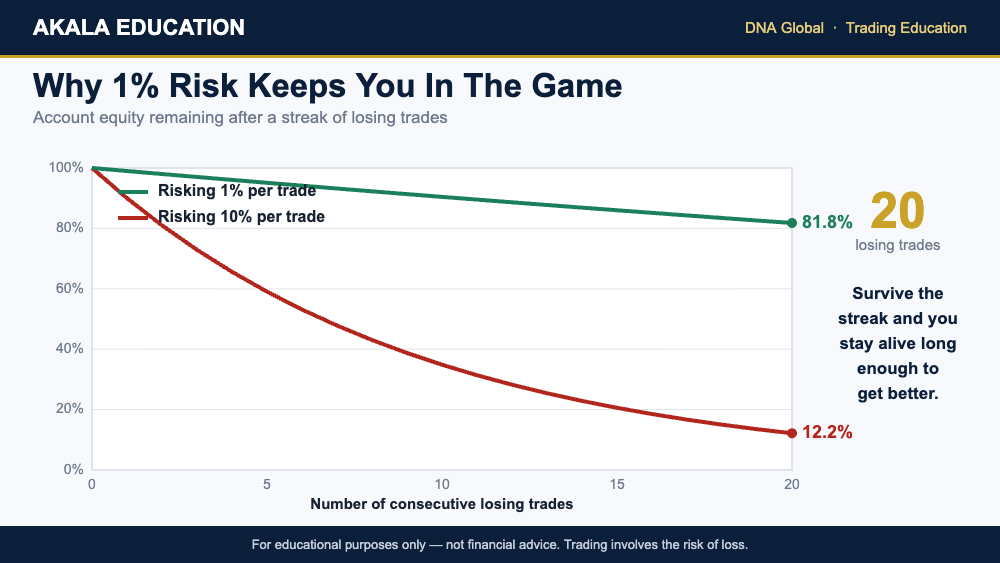
This is the foundation rule. On a $1,000 account, you accept a maximum loss of $10 per trade. Sounds tiny, right? But it lets you be wrong 20 times in a row and still have capital to keep learning.
Beginners often think 1% risk is too slow. They risk 10% per trade, win a few, feel great, then one losing streak wipes it all out in a week.
2. Size your position from the stop loss
This is where beginners do it backwards. They pick the position size first, then place the stop loss on a whim. Do it the other way around.
You decide how many dollars you’ll lose first. Then place the stop loss where it makes sense on the chart. That stop distance is what determines your position size. The dollar risk is the constant; the size is the variable.
3. Have a daily and weekly loss limit
I set my own rule: down 3% on the day, the screen goes off. Down 6% on the week, I rest until next week. This rule doesn’t protect your money. It protects you from the worst version of yourself — the version that wants to win it back at any cost.
4. A reward-to-risk of at least 1:2
On each trade, the expected reward should be at least 2 times the risk. With that ratio, you only need to be right on 4 out of 10 trades for the account to inch up. You don’t need to win often. You need to let winners run big enough and losers stay small enough.
On leverage and the money you use
Two honest reminders for beginners. First, leverage isn’t power, it’s speed. It gets you to the finish line faster, and it drives you off the cliff just as fast. Beginners should use the smallest leverage possible while learning.
Second, only bring to the market money you can truly afford to lose. Never trade with tuition money, rent money, or borrowed money. Because when you’re afraid to lose, you’ll break every rule above.
From wiped out to still standing
My first account evaporated in a few weeks. I once put a full 20% of my capital on a single trade because I was “sure about this one.” That trade was wrong, and I lost nearly a third of the account in a single afternoon.
The turning point wasn’t a new strategy. It was the day I pulled my risk per trade from 20% down to 1% and started journaling. Six months later, I still wasn’t rich. But for the first time, my account survived a losing streak without a scratch.
After years alongside new traders in the DNA Global community, I see one thing clearly. The ones who last longest are almost always the ones who entered the market with the tightest capital rules, right from the start.
Start today
You don’t need to remember this whole article. Just do one thing on your next trade. Calculate first: if I’m wrong, what percent of the account do I lose? If that number is bigger than 1%, lower your position size. That one small habit alone separates you from the crowd that blows up in the first year.
The DNA Global community isn’t for people hunting hot setups. It’s for beginners willing to build a solid capital base before thinking about profit. If that’s you, come join us. We learn capital management for education only — no signals, no hype.
A good beginner isn’t the one who wins fastest. It’s the one who survives long enough to get good. While you still have capital, you still have a chance.
For educational purposes only — not financial advice. Trading always carries the risk of loss; you can lose part or all of your capital.