



New
FOMO Is the Most Expensive Feeling in Trading
I wrote this for the version of you who’s awake at midnight — finger trembling over Buy, terrified that if you don’t get in now, you’ll be left behind. I’m Brian, and I once sat in that exact chair. FOMO trading cost me more than you’d guess, and almost none of it was money.

4 a.m., a gold candle shooting straight up — and my finger was already on Buy
4 a.m. The room dark, only the screen lighting my face. On the XAUUSD chart, a green candle stood straight up — gold was running. Really running. And I didn’t have a single position in that wave.
My heart beat faster than the candle. A voice in my head, not loud but relentless: Get in. Everyone’s eating, and you’re standing outside. My palm went damp. The cursor had already drifted to the order box. My finger settled on Buy — no plan, no stop, no reason on earth except the fear of being left behind.
And I knew it all by heart. I knew what FOMO was. I knew entering like this was entering blind — no entry level, no stop loss, just emotion holding my hand to the button. I had lectured other people about patience. Yet that night, the man giving the lecture was shaking harder than anyone.
Here’s the question that pinned me to the chair:
Why does a man who knows discipline cold still let fear press that button?
I’d pressed it before. In late, right at the top. Then sat watching the reversal swallow it whole. Not because I lacked knowledge — but because in that moment, I no longer owned my own hand. The enemy wasn’t on the chart. It was sitting in my chair.
What FOMO trading actually is — and the real price of one candle I couldn’t bear to miss
Let me finish that night.
I took the trade. Fifteen minutes later, price reversed.
I watched the number in my account turn red. But the thing that ran cold down my spine wasn’t the figure ticking down — it was the question that surfaced: what did I just lose money on?
Not on misreading the chart. Not on missing some indicator. I lost on a feeling. And that’s the real price. Money comes back. Realizing you just let a spasm of fear stand in place of judgment — that costs more.
Let me name the thing that emptied my wallet.
FOMO trading — fear of missing out — is when you chase a wave that’s already running and jump in late, usually right at the top or bottom, with no plan and no stop. It isn’t a technical mistake. It’s a crack in your trading psychology, wearing the costume of an “opportunity.”
And this is the lesson you only feel once you’ve paid for it: it was NOT that I lacked knowledge — it’s that I let fear move my hand for me. I knew stop-loss theory like the back of my hand. But theory sits still in your head, while the finger shakes along with the fear.
It’s like photography. Try to cram everything into one frame because you’re scared of missing anything, and you catch nothing in focus — the whole shot blurs. The market is the same. Grab at every wave because you can’t bear to miss one, and you won’t land a single clean trade.
When you enter because you’re afraid of missing out, you aren’t buying the wave. You’re buying your own fear.
The most expensive feeling isn’t greed — it’s the fear of being left behind
But if I stop at “it’s a feeling,” I still haven’t named it right. It took me years more before I could look it in the face.
I used to think traders blow up out of greed. Too big, held too long, never full enough. I believed that for years — until I went back through the most painful trades of my life and found something else. I didn’t lose because I wanted more. I lost because I was terrified I was the only one standing outside the party.
That truth is hard to swallow. Because it never shows up on the price ladder.
Greed is at least decent: once it’s full, it lets go. Fear doesn’t. It dragged me onto a running wave at the worst possible moment — latest, highest, thinnest. I wasn’t pressing the button because I saw an opportunity. I pressed because I couldn’t stand watching everyone else eat while I sat empty-handed.
Greed knows when to stop, because it stops when it’s full. Fear never does — because a frightened mind never gets as far as thinking about a stopping point.
I learned to swim late. And the biggest lesson underwater wasn’t in the arms and legs — it was in the panic. The more I feared sinking, the harder I thrashed. The harder I thrashed, the more I strained. The more I strained, the deeper I sank. The people who float are the ones who dare to go loose, who trust the water to hold them. Entering a trade out of fear of missing out is exactly that thrash underwater — it looks like swimming, but it’s drowning.
The fear of being left behind is deeply human. There’s nothing to be ashamed of. But here’s the cruel part: the same instinct that kept our ancestors alive in the wild is the very thing that drains your account in the market.
So if every month you find yourself “unlucky” again, try pausing for a beat. Maybe you’re not greedy. Maybe you’re quietly paying a fee — the fee on fear — that no statement will ever print by name.
And that is the most expensive feeling of all.
There’s always a next train: the morning I changed the question in my head
Naming the fear didn’t free me from it. What changed everything wasn’t a new strategy — it was one morning when I sat down and counted.
Cold coffee in my hand, I opened the calendar. Five days a week. Fifty-two weeks a year. And this market will stay open for the rest of my life.
I went still.
How many times had I hit Buy just because I was scared “this wave is the last one”? But there is no last wave. The opportunity out there is endless — it runs forever, with or without me. What’s scarce isn’t the setup. What’s scarce is my capital and my calm. Those are the things that can actually run out.
Missing one wave won’t kill me. Chasing the top out of FOMO will.
Picture a person on the platform, one foot already lifted, heart pounding because they’re scared of missing the train. But here’s what no one tells you: there’s always a next train. And the next one comes to a full stop so you can step on properly — instead of hurling yourself at a moving car and landing flat on your face.
That morning I changed one question. Just one.
Before, every time a candle shot up, my head screamed: “Am I missing out?” That question dragged me chasing everyone else’s setups. I traded it for: “Is this MY setup?” Three words. It moved me from the passenger seat to the driver’s.
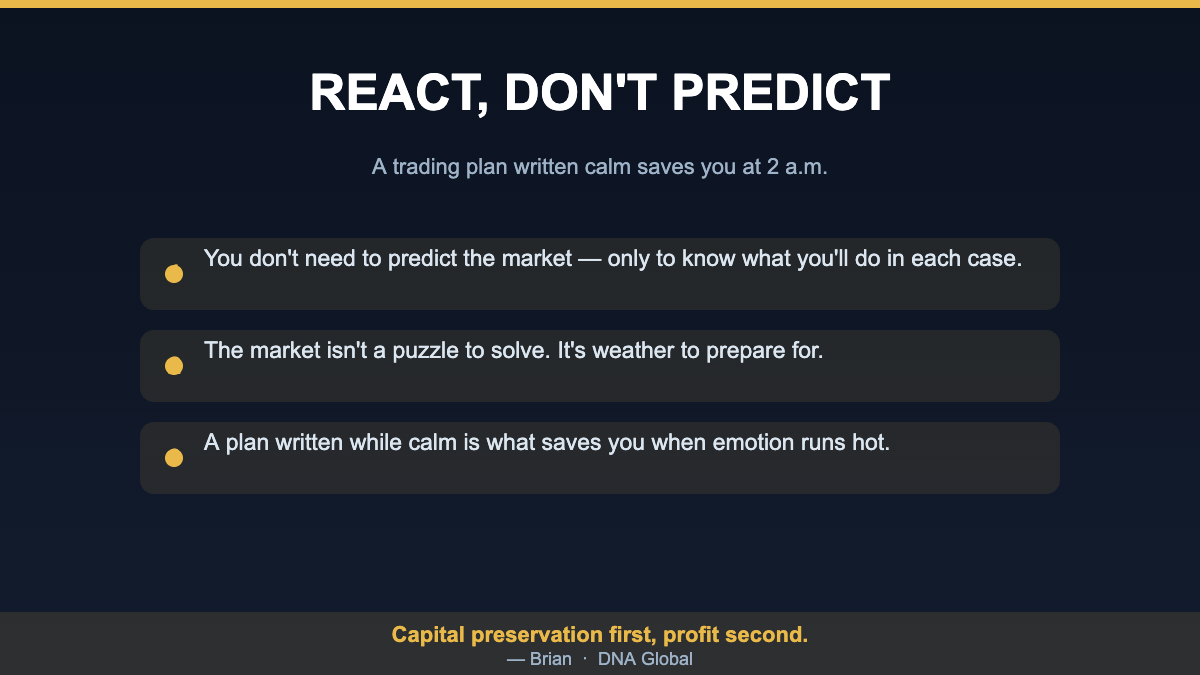
That was also when React, don’t predict finally landed. I stopped guessing where the next wave was headed — because when did I ever know? I just respond according to my system. Like running long distance: I don’t sprint against the person beside me, I hold my own pace. The one who breaks away hardest at kilometer 3 is rarely the one who finishes.
Opportunity is infinite, capital is not. The survivor guards the finite and refuses to chase the infinite.
Protect capital first. Profit second. As for your setup — it will come. Your job is to still be here when it does.
How to control FOMO: the 3 questions I ask before my hand touches Buy
Changing the question in your head is one thing. But the head forgets, especially when the heart is racing. So I had to turn it into something I could hold.
After that night of staring at a red account in silence, I didn’t swear any oaths. I just did one small thing: I wrote three questions on the back of a notebook and taped it beside the screen. So next time, when the candle shot up and the heart pounded again, I’d be forced to read them before my finger could reach the button.
One: Is this a setup from my plan, or a setup I just saw? My setup was on paper from last night — cold, with a clear entry zone. The setup I just saw was born three minutes ago, in the heat. Those two are not the same thing.
Two: Do I already know where I’m wrong? If I don’t know my stop level yet, I’m not entering a trade — I’m placing a bet. Protect capital first, profit later. Without a predefined stop loss, the Buy button is just a trigger.
Three: If I miss this wave, do I actually lose anything tomorrow? Almost always: no. The market is open again in the morning. The only thing I lose if I jump in blind is capital.
Just one “no” answer — that’s FOMO knocking.
And here’s what took me years to understand: discipline isn’t gritting your teeth and saying NO in the middle of the wave. Grit cracks eventually. Discipline is building a plan that says NO for you, before emotion gets a chance to open its mouth. The plan you write while you’re still cold is a promise you send to the panicked version of yourself at midnight.
I used to believe the money lived in the perfect entry point. Wrong. The entry was never the problem — managing capital and managing emotion was. If you want the longer version of that, I wrote it in You Don’t Beat the Market, You Beat Yourself.
And a good photo isn’t the one stuffed with the most things — it’s the one that cut the right excess. Choosing setups is the same: a trader’s biggest job isn’t finding more to enter, it’s brushing aside the ones that aren’t yours. Waiting for the right setup is an art of elimination.
Those three questions don’t help me win every wave. They just keep me from losing to a spasm of feeling. For a trader, surviving to the next session — often, that already counts as winning.
I don’t build a signal caller — I build the person who sits steady at the screen
Those three questions were something I built for myself. But the further I went, the more I understood one thing: the hard part isn’t writing the three questions — it’s sitting still long enough to read them. And very few people manage that alone.
There was a stretch where I thought my job was to point out the prettiest entry. A number. An arrow. A reason to press the button. I was wrong.
Because what people lack was never the arrow. What they lack is the ability to sit still while the whole screen screams “get in, you’re late, it’s over.”
I’ve met too many people carrying a victim story in their heads. The market played me dirty. I just missed the life-changing wave. I open my phone and everyone’s flashing profits, only I’m standing outside. I don’t judge them — I lived inside that story. But I know where it leads: to a finger pressing Buy by itself at midnight, then blaming the market by morning.
So I don’t build a signal caller. I build the person who sits steady at the screen.
And I’ll say it plainly, even when it grates: no one can promise you’ll win every wave. Anyone selling you the feeling that you “can’t afford to miss out” is not on your side — they’re taking your own fear and selling it back to you as merchandise. I paid the tuition for that lesson. So I can’t bring myself to watch you pay it again.
I didn’t choose to be a signal-caller star — the kind who leaps from one train to the next, blazing for a season, then going dark. I chose, with DNA Global, to lay the rail one bar at a time. Rail doesn’t sparkle like fireworks. But fireworks last one night — rail carries people far.
The person in charge doesn’t ask “what did I just miss?” They ask “what does my next setup look like?” The question sounds small. But it’s the line between the person the market leads by the nose and the person who sets their own foot on their own rail.
Frequently asked questions about FOMO trading
What is FOMO trading?
FOMO trading — fear of missing out — is when you chase a wave that’s already moved, entering with no plan and no stop loss, just because you’re scared of being left behind. You aren’t buying the wave. You’re buying your own fear.
How do I control FOMO when trading?
Before your hand touches Buy, ask three questions: Is this a setup from my plan? Do I already know my stop loss? If I miss this wave, do I actually lose anything? One “no” — that’s FOMO knocking. Discipline isn’t forcing yourself to resist; it’s having a plan ready to say “no” for you.
Why does FOMO make traders chase the top?
Because fear pulls you in exactly when the wave has traveled farthest — where the risk is largest and the reward thinnest. You enter last, then carry the full weight of the reversal.
Is it bad to miss a wave?
Not at all. The market opens every day and opportunity is infinite — what’s finite is your capital. Missing one wave won’t kill your account. Jumping in out of fear of missing out will.
Trading Forex/XAUUSD carries high risk and you can lose your entire capital. This content shares experience and is not investment advice.
You’re not broken — you’re just alone
That night, I sat alone in a dark room, watching a red candle swallow my account. No one beside me. No one to ask. Just me and the hand that had pressed the button instead of the head.
I’m telling you this not so you’ll pity me. I’m telling you so you’ll know: that loneliness in front of the screen at 2 a.m. — I lived in it. And I know how it lies to you.
It whispers that you’re stupid. That everyone’s winning, only you lose. That you’re broken somewhere. It’s lying. You didn’t lose because you’re weak — you lost because you sat alone, with no mirror to show you back your rushed click.
Alone, fear is the one giving orders. With someone beside you, fear becomes just an empty chair.
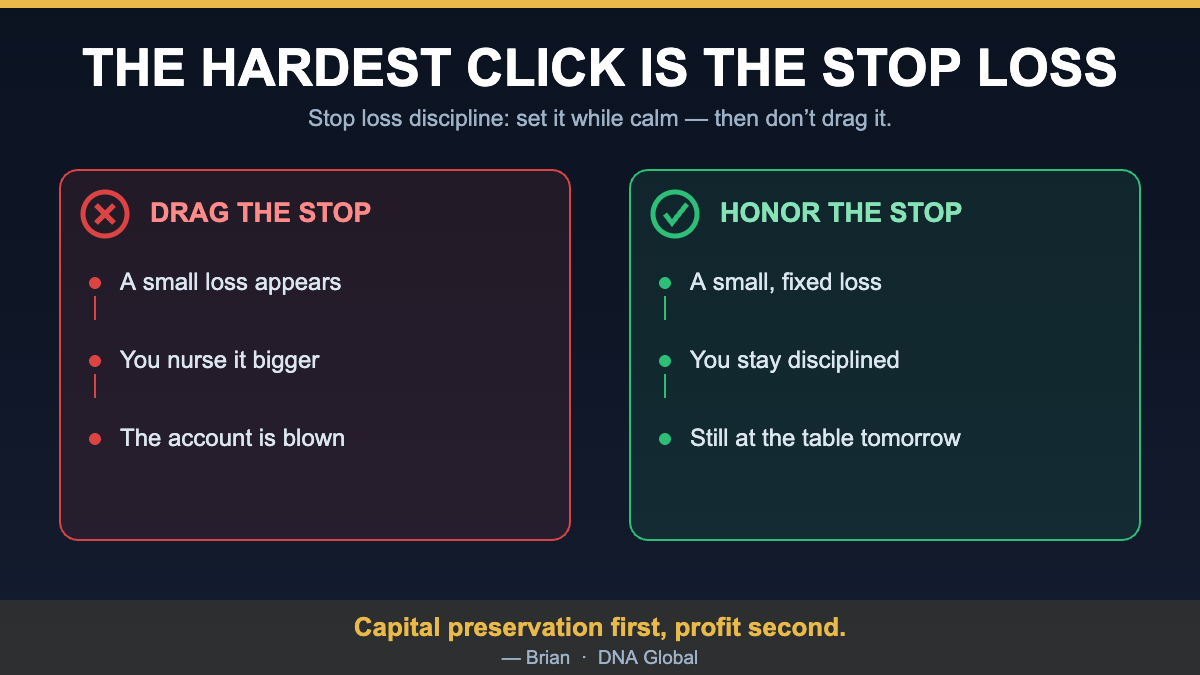
If you’re tired — tired of scrolling past everyone’s profit screenshots while you quietly watch your own screen go red — then come over. Sit next to me and the people learning to wait for their own setup. Not so I can press the button for you. So someone can look back, with you, at the root: capital, emotion, discipline. If clicking the stop is what undoes you, The Hardest Click Is the Stop Loss is where I’d start.
FOMO is the most expensive feeling in trading. But the steepest price of that fear, you don’t have to pay alone.
Alone you go fast. Together you go far. I choose to go far — and I’d like to bring you along.
You’re not broken. You’re just alone. And that one’s fixable — starting today, with the first person you dare to sit down beside.
About the author
Brian — founder of DNA Global, a training community for Forex/XAUUSD traders. I once believed the right entry would change my life, chased the top out of FOMO, and “paid tuition” through nights staring at a red account. In the end I chose to build a SYSTEM rather than be a signal-caller star — and to walk alongside traders retracing the road I’ve already walked. Away from the trading desk, I run marathons and swim — two places that taught me holding form matters more than forcing effort.
Trading Forex/XAUUSD carries the risk of capital loss; this content shares experience and thinking, not buy/sell recommendations or profit guarantees.
— Brian